








Article & Photo is courtesy of PregPrep.
Before even becoming pregnant, many women start taking steps to prepare their bodies for pregnancy. That is why Nine Naturals is excited to partner with PregPrep in the Make That Baby Series to help bring you helpful tips and information for preparing for pregnancy.
The anecdotal evidence is vast. Most of us have heard at least one story about a couple that struggled to conceive until they went on an island vacation. Or we know someone who couldn’t get pregnant until graduate school was over and they had feathered the nest. But in order to provide a more scientific answer to this question, we first need to lay out the basic science about the human response to stress.
It has been long understood that our bodies are hardwired to protect us from mortal danger. Most of us have heard of the “flight or fight” response triggered in extreme life or death situations, in which our bodies receive a surge of heightened energy and focus needed to survive a lion attack or outrun a tsunami.
In modern life, we are not as vulnerable to constant threats to our very survival, but the wiring is still in place. For many of us, this reaction is still set off by external pressures such as a looming work deadline or problems on the home front related to marriage and family.
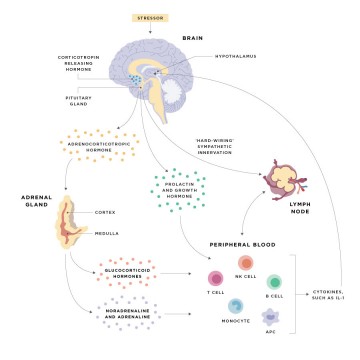
When the stress response is set off, three different hormones come into play:
The first is adrenaline, also known as the “fight or flight” hormone. When that shark fin on the water is spotted, the brain sends an urgent telegram to the adrenal glands, which then flood the body with adrenaline (and norepinephrine, discussed below). Adrenaline helps the body respond immediately to the situation at hand by giving a surge of energy and heightened focus.
The second hormone, also released by the adrenal glands, is norepinephrine, which acts as a back-up system to adrenaline, giving the brain the hyper focus needed for a quick response time. It also directs blood away from less important areas, like the skin, to the muscles that may need support for a quick get-away.
Finally there’s cortisol, commonly known as the “stress hormone”. Cortisol does not kick in immediately like adrenaline, because it is only activated after the message is received by the amygdala and hypothalamus — two areas of the brain directly related to the regulation of many autonomic functions, including reproduction. It’s a key player in the stress-circuit trifecta, because it regulates fluid balance and blood pressure. It also offers a clue to the possible negative effects of stress on reproduction, as it can suppress reproductive drive in times of extreme stress as a protective measure. Cortisol inhibits the production of gonadotropin, the body’s primary sex hormone (GnRH) and, in turn, can suppress ovulation and sex drive. Mammals have been observed to shut down reproductive functioning completely in times of acute distress.
In 2009, researchers at UC Berkeley discovered that stress also increases levels of the recently discovered (2000) hormone gonadotropin-inhibitory hormone GnIH. This hormone, like cortisol, suppresses GnRH. This fascinating finding implies that the reproductive system is impacted from more than one angle in times of stress.
This primal protective measure, so crucial in times of true physical crisis, can work against the body when a chronic-stress response is triggered in everyday life.
A study by NIH and the University of Oxford discovered another new stress hormone that may hamper successful implantation of a fertilized egg. They tracked normal, healthy women with no known underlying fertility issues and made an incredible discovery: an enzyme that was previously known to help the body process starch, now turns out to be another key indicator of stress. The enzyme, alpha-amylase, may reduce blood flow and in turn slow the passage of the fertilized egg to the uterus. The study also showed that women with higher levels of alpha-amylase were less likely to conceive in their fertile window. This compelling study has now spurred other scientists to conduct further, long-term research.
So does any of this prove that the body’s response to stress negatively impacts fertility? The growing body of research seems to suggest that the hormones released in stress response do hinder the reproductive functions as part of the body’s primal “fight or flight” defense. The older belief that ovulation was only hampered by acute stress is now being chipped away. Daily and chronic low-level stress can also have an impact on fertility and reproductive health. It may be more subtle but still is a problem.
The old “just relax and it’ll happen” advice is just as useless and irritating to those on the road to conception as ever. But there is certainly enough scientific evidence to inspire healthy couples who hope to conceive easily and find effective ways to manage their everyday stress. In the process, they may also overcome some of the other scourges of chronic stress: stubborn belly fat, lowered immunity, and plain old unhappiness.
As you prepare yourself for pregnancy, Nine Naturals knows that you are thinking about everything that you put in and on your body. Nine Naturals is excited to offer the Nine Naturals + PregPrep Bundles, featuring Nine Naturals products of your choosing with the PregPrep Make that Baby Kit! Detoxify your beauty routine with luxurious all natural & sulfate-free products and get key nutritional support to bolster fertility and promote ideal reproductive health with physician-formulated natural supplements in the PregPrep Make That Baby Kit.