








Posts Tagged ‘green’

Creating a Green Nursery … a Healthy Space for your Newborn!

Screen Shot 2013-10-09 at 3.00.41 PM

Every mom wants to create a beautiful nursery for her new baby. It’s one of the first physical gifts we as parents give our child and we want it to be as much a manifestation of adoration as four walls can muster.
We at Nine Naturals know the feeling. We also want to help new parents create a nursery that is as safe as it is stylish.
Make it organic? Sure, but let’s be more specific. Setting up a green nursery is not just about following the organic trend. It’s a way of helping to ensure your baby’s health and well-being in his or her earliest years.
Nine Naturals’ recommendations for a truly green and safe nursery:
  1. Keep the room ventilated! An unseen threat to a green nursery is the presence of VOCs, or volatile organic compounds, which are released (or “off-gassed”) by thousands of products. These compounds are used to help paint spread and eventually dry. VOCs pose long-term risks to human health and the environment. And although VOCs are everywhere, it’s indoor air that tends to have higher concentrations of VOCs. Remember to avoid VOCs at all costs, especially in your little one’s new room.
  2. Avoid exposure to harsh fumes that can emerge from traditional paints and lack of air flow. Avoid major home renovations during pregnancy, which can increase chemical exposures, or try to avoid being in the house during the work. Purchase no-VOC paints, and ensure that the future nursery has excellent ventilation — particularly while it’s being painted.
  3. If you must use carpets, be very, very picky. Carpets can serve as home to allergens and dust mites. Further, many synthetic carpets are made with latex backings, and these backings as well as the adhesive used to affix them to floors can release VOCs by “off-gassing.” Looking for an alternative? Try a rug made of natural fibers like wool or cotton that does not come with a synthetic backing.
  4. Buy toys made from natural materials. Ensure that all of your baby’s toys are nontoxic, non-PVC, non-BPA and non-phthalate. In other words, look for toys made of natural materials such as wood or silicone. Before you know it, your baby will be sucking and teething on everything in sight. PVCs can leach harmful phthalates, and BPA (bisphenol-A) can also impact your baby’s long-term well being. We prefer toys made from organic cotton and sustainable wood. Check out Plan Toys for some great options.
  5. Choose organic or natural fiber bedding. Why? Your baby is going to spend a large part of his or her early years sleeping in a crib. Most crib mattresses on the market contain toxic chemical fire retardants, which have been associated with many health issues. Organic cotton, natural wool, or bamboo mattresses and bedding are friendly to both the environment and your baby’s skin. We like brands like Nook and Naturepedic.
  6. Purchase a crib and baby furniture sourced from certified sustainable or reclaimable materials. Ideal furniture pieces also completely avoid the use of VOC’s and formaldehyde – not only in their wood, but also in their paint, glue, and or resin. Take a look at beautiful designs from Oeuf and Duc Duc or for a cheaper alternative, consider Ikea.
  7. Opt for all-natural, nontoxic, and chemical-free cleaning supplies to maintain a tidy green nursery. You should be able to read and understand, simply from the label, every single ingredient that your cleaning products contain. Green products are environmentally sustainable and their ingredients are safe for your baby to touch or inhale. Our founder Grace uses Dapple in her daughter’s nursery.
  8. The same principles apply to other baby needs like clothing and diapers. You spent nine months making a natural environment for your growing baby in the womb - keep it up in their nursery!

What tips would you add to our list for the ideal green nursery?
Green Tip! - Be an Environmentally Conscious Consumer

green tip, environmentally, environmental, conscious, shopper, farmer's market

Annually, Americans throw away a whopping 100 billion plastic bags. According to a 2004 study by Worldwatch Institute, that’s the energy equivalent of 12 million barrels of oil. Most plastics bags end up in streams or other bodies of water where they clog up the waterways and cause long-term and life-threatening damage to the marine life. Virtually non-biodegradable, plastic bags will stay wherever they end up being dumped for nearly 1,000 before they start to “break down”. To put it simply, the usage of plastic bags is in no way beneficial to the environment or the future generations.

But being an environmentally conscious shopper means more than just avoiding the usage of plastics bags. Here, we share a couple of tips.

  • Bring your own reusable bag. This has been a popular trend in the recent years. Shoppers have been bringing their own reusable bags to tote their groceries and purchases home instead of using the plastic bags given out at the store. Many stores themselves are now selling reusable bags and give out a small discount for customers who opt to use reusable bags instead of plastics bags. In the long run, using reusable shopping bags could be quite profitable, who knew?
  • Avoid products that use a lot of packaging. For some products this can’t be avoided such as electronics and such but this tip is simple to apply to food. Try to buy fresh food. The fresher it is, the more likely it is to have less packaging. Because if you think about it, pre-packaged foods such as microwave dinners and snack bars most likely contain more artificial preservatives than fresh foods. Not a concrete rule but just something to keep in mind.
  • Buy in bulk. This tip ties in with the one above. Buying in bulk cuts down on all the extra bells and whistles of conventional packaging. And if that’s not enough reason to buy in bulk, it’s an economical choice too!
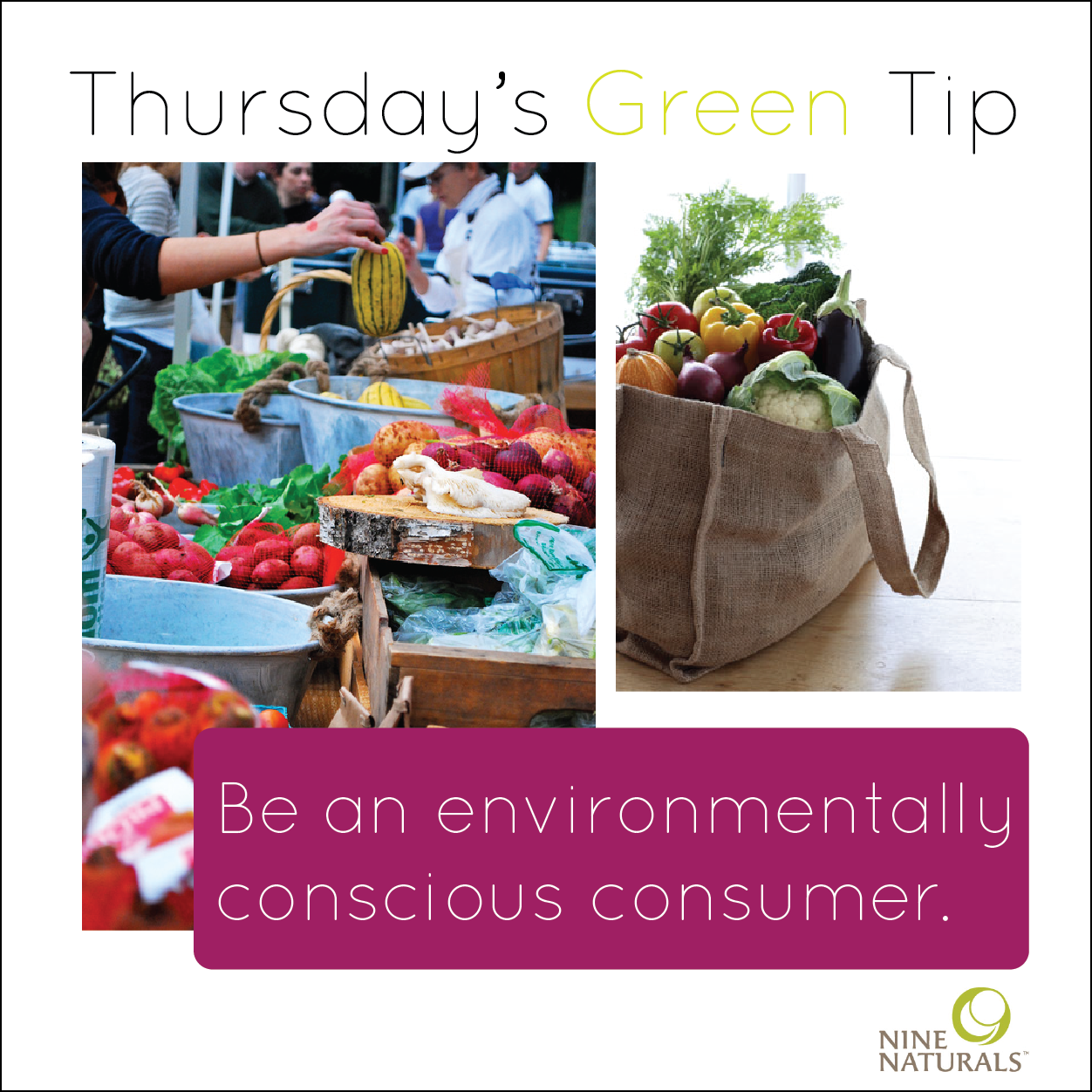
  • Support you local farmer’s market. This is a win-win situation for your local agricultural community and for environment. By buying local you’ll be supporting local farmers. Plus, the fruits and veggies found at farmer’s markets need not to travel cross-country before it arrives at your plate, helping prevent unnecessary greenhouse gas emissions.

Green Tips for Laundry Day!

Laundry just seems to be one of those endless tasks. Whenever, wherever, there is always more laundry to be done. And it appears that laundry is no easier on us than it is on our resources. Conventional washing machines require about 40 gallons of water per load. Multiply that by the average amount of laundry an American family does per year (a whopping 400!), that’s nearly 1600 gallons of water needed for a year’s worth of clean clothes for a typical American family.

As for the amount of energy that goes into laundry days, nearly 90% of the electricity used for laundry is spent on simply heating the water for washing. And as for the drying, the average clothes dryer costs an approximate $1,530 to operate for the entirety of its useful life.

So there’s no easy way to spin it, but we have a couple of tips to lightening the load on you, your wallet and the environment.

1. Replace your top-loading for a front-loading washing machine. This may sound like a hefty investment but in the long run it’ll be worth it. According to the California Energy Commission, the U.S. Department of Energy recently did a study in a small town in Kansas, where 204 older washing machines were replaced with horizontal axis machines. Homeowners there realized an average of 38 percent savings on water usage and 56 percent energy savings for the washer and hot water heating system. The reason being front-loading machines don’t need to fill the tub completely with water, thus, saving money and time.

2. Use naturally derived detergents. What you use to wash your clothes goes back into the environment, so please be kind. Plus, if that’s not compelling enough, conventional detergents include chemicals we should be wary of washing our clothes in. Clothes that are then worn against our skin, which may absorb those same harmful chemicals into our systems.

3. Wash your laundry in cold water. Simply doing so preserves the color of the clothing and keeps it looking new. But beyond that, you’ll be saving on the electricity that goes into heating the water for washing, approximately 0.24 kWh, which translates to about .41 pounds of CO2 per load, 162 pounds of CO2 per year, 8 gallons of gas, or 164 miles of driving.

4. Use wool dryer balls. Not only are they reusable, helping eliminate the need for dryer sheets, dryer balls are relatively inexpensive and last for an average of 2 years before needing to be replaced. As another plus, dryer balls help reduce drying time by 40%.

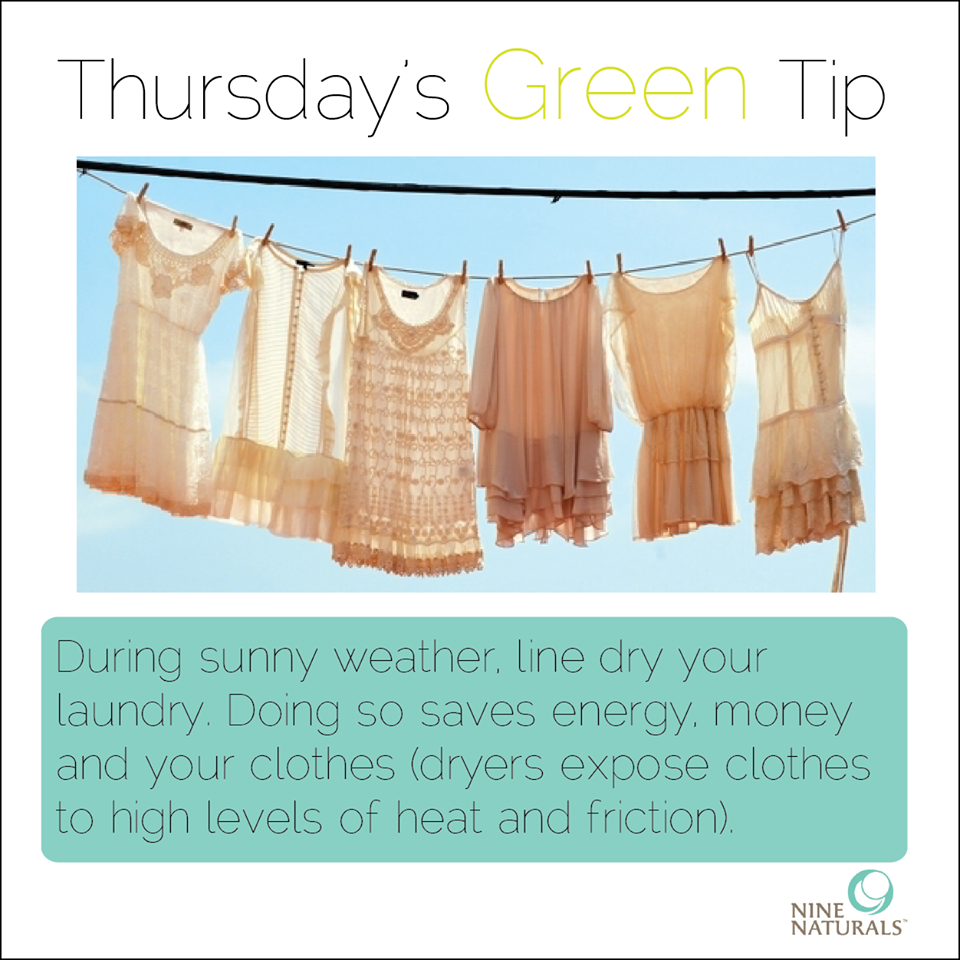
5. As we shared on our Facebook, line-dry your clothing. Doing so saves you 100% in costs. There’s no need for dryer balls or sheets or electricity, just sunshine and a clothing line. The only downside to line-drying is that it can only be done during warm months but aside from that, there’s absolutely nothing to lose. Line drying reduces static cling, wear and tear on clothing, saves money spent on electricity and products and is all the way environmentally friendly.